
Data fluency is a term that gets used a lot, often interchangeably with data literacy. In practice, this creates confusion. People assume it is about technical skill, dashboards, or learning another tool. That misunderstanding is one of the reasons organisations struggle to make progress with data, even when they invest heavily in systems.
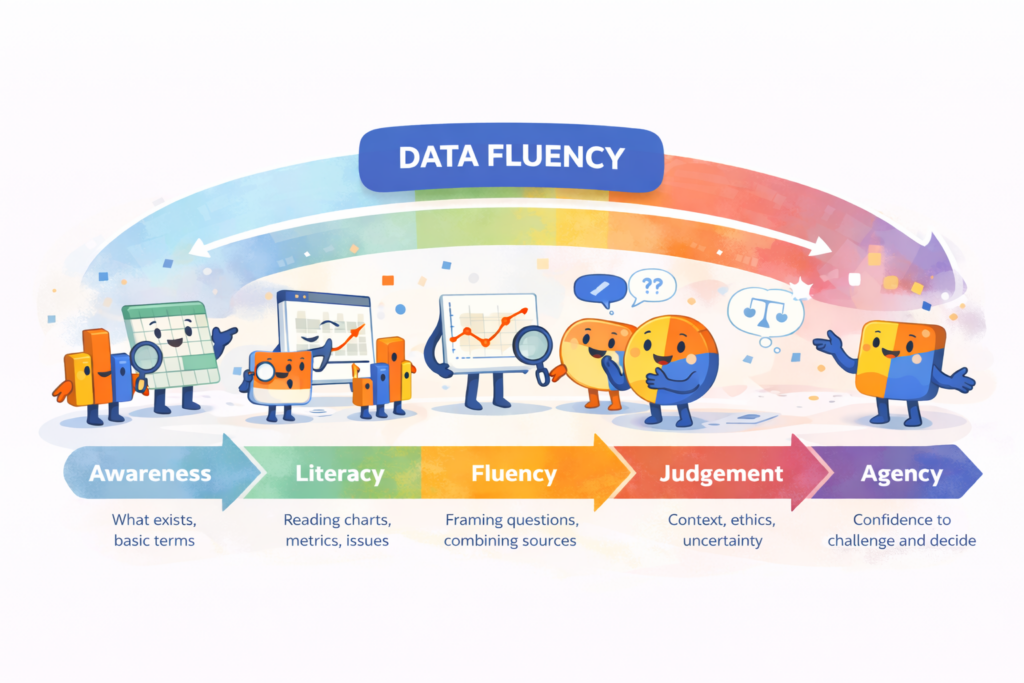
I find it more useful to think of data fluency as a continuum of capability, not a single skill. It describes how confidently and effectively someone can work with data, from knowing it exists through to using it to make and justify decisions.
Below is the model I use, along with guidance on how individuals and teams can assess where they currently sit.
The data fluency continuum
Awareness
At this level, people know that data exists and have a basic grasp of terminology. They may know where reports live, what certain datasets are called, and which team is responsible for them.
This is often where people first enter the data conversation. Awareness is essential, but on its own it does not support decision-making.
Signs of awareness
- You know which datasets or reports exist
- You recognise common terms and acronyms
- You know who to ask for data
Literacy
Data literacy is about interpretation. People at this level can read charts, understand common metrics, and spot obvious issues such as missing values or figures that do not make sense.
This is where many training programmes focus, and with good reason. Literacy is foundational. But it still tends to be reactive rather than proactive.
Signs of literacy
- You can interpret charts and tables accurately
- You understand what key metrics mean
- You notice inconsistencies or basic data quality issues
Fluency
Fluency is where data starts to become genuinely useful. It is about framing questions, selecting appropriate measures, and combining sources to explore an issue rather than just reporting on it.
At this stage, people stop asking for “the data” and start asking better questions of it.
Signs of fluency
- You can translate a problem into a data question
- You choose measures deliberately rather than by habit
- You combine datasets to gain insight
Judgement
Judgement is about understanding context, limitations, and uncertainty. People at this level recognise that data is never neutral and never complete.
This includes ethical awareness, an understanding of bias, and the ability to explain caveats clearly. Judgement is critical in environments like higher education, where decisions have real consequences.
Signs of judgement
- You understand the limitations of the data you use
- You consider context and unintended consequences
- You are comfortable discussing uncertainty and assumptions
Agency
Agency is the outcome of fluency, not a separate technical skill. It is the confidence to challenge, explain, and decide using data.
People with agency do not just consume data. They use it to influence decisions, justify actions, and push back when something does not feel right.
Signs of agency
- You confidently explain data to others
- You challenge decisions using evidence
- You use data to support action, not just analysis
How to assess where you or your team sit
A useful way to use this model is not to ask “what level are we at?” but to look for patterns and gaps.
For individuals, consider:
- Where do you feel confident, and where do you rely on others?
- Do you spend more time interpreting data or framing questions?
- Are you comfortable challenging conclusions based on data?
For teams, ask:
- Are most people clustered at the same level?
- Do managers sit at a different level to analysts?
- Where do decisions stall, interpretation, confidence, or trust?
It is very common to find strong literacy but weak fluency, or good fluency without judgement. These gaps matter more than the average level.
Why this matters now
As organisations increasingly talk about AI and automation, data fluency becomes even more important. AI amplifies whatever capability already exists. If people lack judgement or agency, AI does not solve that problem. It makes it riskier.
Improving data fluency is not about turning everyone into a data specialist. It is about enabling people to ask better questions, make better decisions, and take responsibility for how data is used.
That is what moves an organisation forward.