
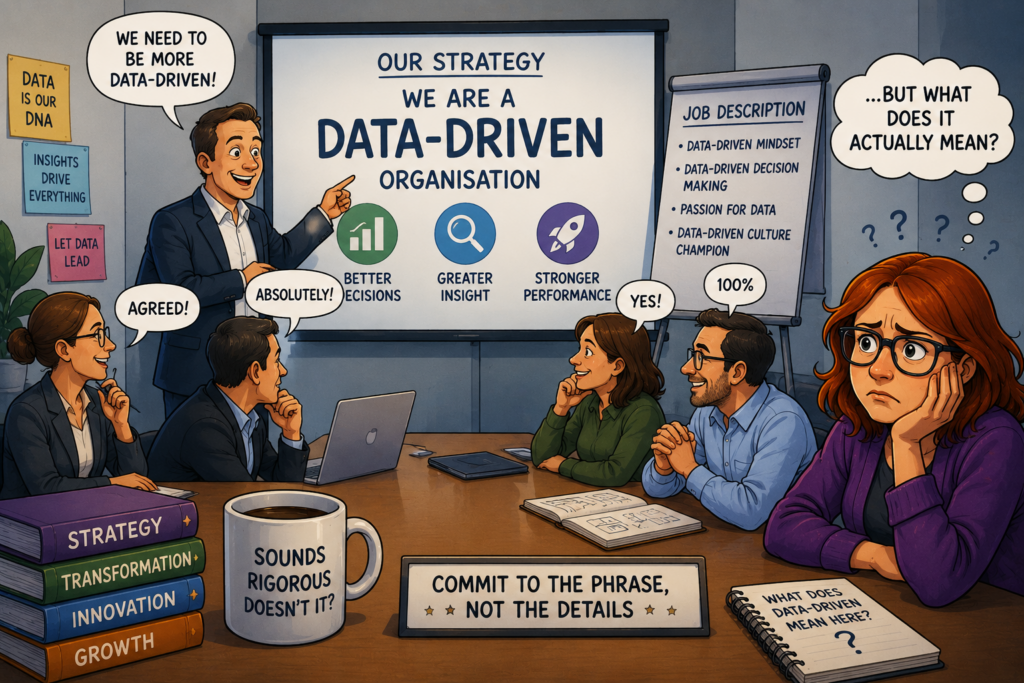
“Data-driven” has become one of those phrases that organisations put in strategies, say in meetings, and include in job descriptions without anyone stopping to ask what it actually means in practice. It has the comfortable quality of sounding rigorous without committing to anything specific. And that, unfortunately, is usually where the trouble starts.
Let’s be honest about what data-driven often looks like in reality. It looks like a dashboard that took three months to build and that two people actually check. It looks like a decision that had already been made, with data assembled afterwards to support it. It looks like an annual report full of numbers that nobody interrogated on the way in. It looks like a team that knows they have data, suspects it might be useful, and isn’t quite sure where to start.
None of this is a character flaw. It is an extremely common organisational reality. But calling it data-driven is a stretch.
What it actually requires
Being genuinely data-driven is not about having a lot of data, or good tools, or even good analysts – though all of those things help. It is about culture, habits, and the willingness to let evidence complicate a narrative you were quite attached to.
It requires that data is consulted before decisions are made, not after. It requires that the people making decisions have enough data literacy to ask useful questions of the data they are presented with – not to do the analysis themselves, but to know when something doesn’t add up, when a metric is measuring the wrong thing, or when a chart is doing more storytelling than reporting.
It requires psychological safety around uncertainty. A genuinely data-driven organisation is one where “the data suggests we might be wrong about this” is a welcome contribution, not an awkward one.
And perhaps most importantly, it requires honesty about the limits of the data. Data-driven does not mean data-certain. Good data practice involves knowing what your data cannot tell you just as much as knowing what it can.
The metrics trap
One of the most reliable signs that an organisation is performing data-drivenness rather than practising it is an over-reliance on the metrics that are easiest to collect, rather than the ones that are most meaningful.
If something matters but is hard to measure, it has a tendency to quietly disappear from the conversation. What remains are the things that produce clean numbers – attendance figures, completion rates, response times – which get tracked, reported, and optimised, sometimes at the expense of the things that actually matter most. The data is real. The picture it paints is incomplete. And because it looks like evidence, it rarely gets challenged.
This is not an argument against measurement. It is an argument for being deliberate about what you measure and honest about what you are not capturing.
A more useful question
Rather than asking “are we data-driven?”, it is worth asking something more specific: at what points in our decision-making process does data actually change what we do?
If the honest answer is “not many”, that is useful information. It does not mean the organisation is failing – it means there is a gap between the aspiration and the practice, and that gap is closeable. It usually starts with building the skills and confidence of the people who need to use data, not just the systems that hold it.
Data-driven is a direction of travel, not a badge to award yourself. The organisations that get the most value from their data tend to be the ones that are least satisfied with how data-driven they currently are.