
If you look beyond knowledge work, one thing becomes clear very quickly: well-designed systems do not aim to run at full capacity all the time.
They plan for slack.
In many sectors, this is so fundamental it is barely questioned. In others, particularly office-based and professional work, the same logic is oddly resisted.
How other sectors think about capacity
In manufacturing, buffer stock exists because supply chains are unpredictable. In aviation, safety margins are non-negotiable because the cost of failure is catastrophic. In IT, redundancy is built in because systems will fail at some point.
None of these sectors treat extra capacity as waste. They treat it as the price of reliability.
The idea that everything should run permanently at maximum utilisation would be seen as reckless.
Knowledge work is not exempt from reality
Office-based work often pretends to be different.
Plans assume steady demand. Workloads assume people are interchangeable. Capacity assumes nothing unexpected will happen. When it does, the response is improvisation.
Firefighting fills the gap left by missing buffers.
People become the shock absorbers. Their time, attention, and wellbeing are used to compensate for systems that were never designed to cope with variability.
This works until it doesn’t.
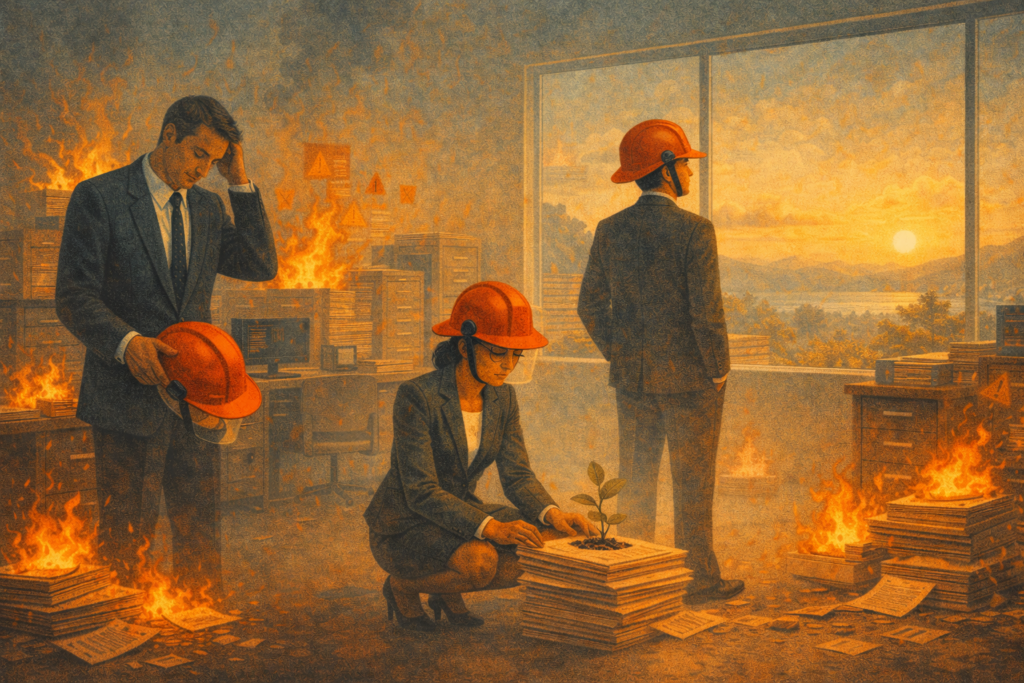
Firefighting blocks the future
One of the least visible consequences of constant firefighting is that it steals the future.
When teams are fully consumed by the urgent, there is no space to improve processes, fix structural issues, or prepare for what is coming next. New technologies are layered on top of shaky foundations. New requirements are met through manual workarounds. Strategic conversations are postponed indefinitely.
Organisations then wonder why change feels so hard.
It is hard because there is no capacity to absorb it.
Extra capacity creates choice
Slack creates options.
It allows teams to respond deliberately rather than reactively. It makes it possible to pilot improvements instead of rushing rollouts. It gives organisations the ability to say no, or not yet, rather than yes by default.
Most importantly, it allows learning to happen.
Learning does not occur under constant pressure. Neither does innovation, reflection, or good judgement.
Redefining strength
There is a deeply ingrained belief that strength looks like coping. Staying busy. Pushing through. Getting it done no matter what.
Resilient systems define strength differently.
They are calm under pressure because they were designed to handle it. They do not rely on heroics because they do not need to. They do not normalise firefighting because they treat it as a sign to investigate, not to celebrate.
A closing thought
Firefighting should not be the norm.
When it is, it tells you something important about how work is designed, resourced, and valued. Extra capacity is not indulgence, inefficiency, or complacency. It is what allows systems to function without breaking people in the process.
If organisations want to be sustainable, adaptable, and future-ready, they need to stop asking how much more they can squeeze out of their teams and start asking what their systems need in order to breathe.
That question changes everything.