
The Lifelong Learning Entitlement is not a distant policy concept. It is a structural shift toward modular, credit-based and episodic engagement.
In the previous articles in this series, I explored why the LLE represents a data reform, and how it exposes governance weak spots. This final article turns the conversation toward preparation.
If you are a senior leader, the question is not whether your institution supports modular provision in principle. It is whether your data model can sustain it in practice.
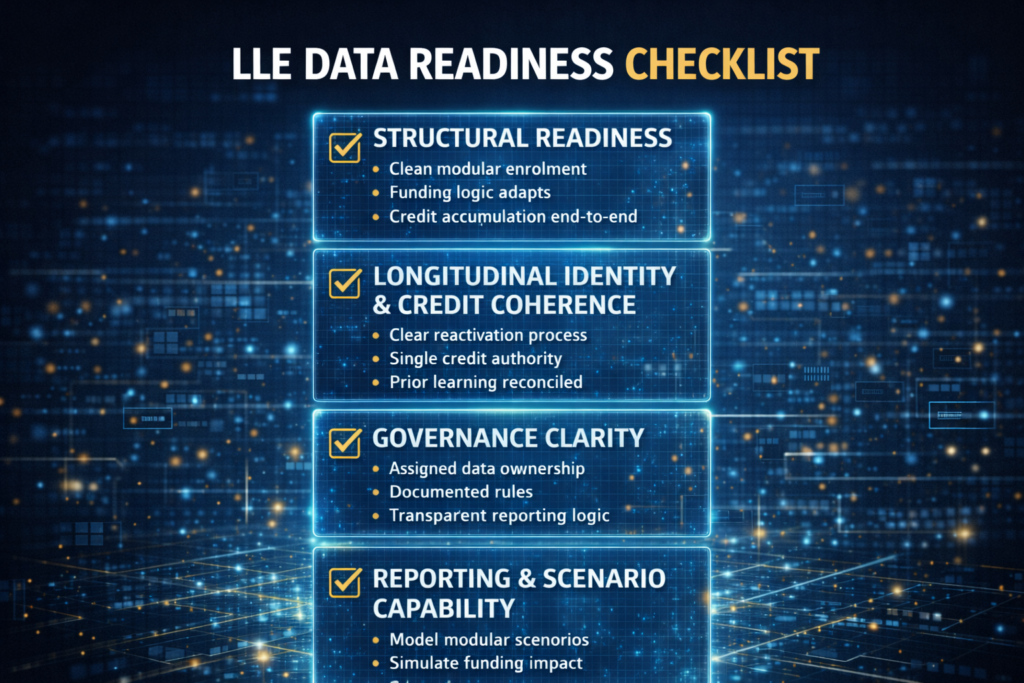
What follows is a strategic data readiness checklist for the LLE era.
1. Structural Readiness
At the most fundamental level, can your systems model modular enrolment cleanly?
This is not about whether modules exist in your curriculum catalogue. It is about whether modules function as coherent, reportable, funding-relevant units within your student record architecture.
Leaders should be confident that:
- Module-level enrolment does not rely on manual reconciliation
- Funding logic can operate at modular level without bespoke workarounds
- Credit accumulation is structurally tracked, not retrospectively reconstructed
If these processes depend on spreadsheet overlays or local interpretation, readiness is transitional rather than embedded.
2. Longitudinal Identity and Credit Coherence
The LLE assumes learners may return over time.
That requires clarity around identity resolution and credit continuity.
Can your institution confidently answer:
How is prior credit recognised and reconciled?
How are returning learners reactivated in system terms?
Is there a single authoritative record of accumulated credit?
Lifelong learning requires longitudinal data coherence. Without it, flexibility increases complexity rather than capability.
3. Governance Clarity
Preparing for the LLE is not only a systems task. It is a governance task.
Under the Office for Students regulatory framework, governing bodies retain responsibility for quality, standards and oversight.
https://www.officeforstudents.org.uk/advice-and-guidance/regulation/the-regulatory-framework-for-higher-education-in-england/
Leaders should be clear on:
Who owns modular data definitions?
Where is accountability for data quality assigned?
Are credit rules formally documented and approved?
Is reporting logic transparent and auditable?
If ownership is diffuse or undocumented, modular complexity will amplify uncertainty.
As I outline in my Data Fluency Framework, institutional capability depends on clarity of data ownership and shared understanding of definitions:
https://thedatagoddess.com/data_fluency_framework/
The LLE is a test of that fluency.
4. Reporting and Scenario Capability
Finally, consider reporting resilience.
Can your institution:
Model modular enrolment scenarios?
Simulate funding implications of episodic study patterns?
Adapt reporting logic as regulatory guidance evolves?
If reporting remains heavily extract-based and manually adjusted, modular provision will increase reconciliation pressure.
A Leadership-Level Readiness Spectrum
Rather than a numerical score, consider which of these descriptions most closely reflects your institution:
Low readiness
Modular activity is supported operationally but relies on manual processes and informal knowledge.
Transitional readiness
Systems can accommodate modular provision, but governance clarity and ownership are still evolving.
Strategic readiness
Modular architecture, credit tracking and governance are structurally embedded and formally owned.
Most institutions sit somewhere between transitional and strategic.
The difference between the two is not technology alone. It is design intention.
Closing Reflection
Preparing for the Lifelong Learning Entitlement is not about predicting exact regulatory detail.
It is about building structural resilience.
Institutions that treat LLE as an architectural redesign opportunity will strengthen their capability beyond this reform.
Institutions that treat it as a policy compliance exercise will manage it tactically, but accumulate long-term complexity.
The question is not whether modular provision is coming.
It is whether your data architecture is designed to sustain it.