
You can have the best dashboard, the clearest definitions, and the most carefully governed dataset — but if your data setup only works as long as a specific person is around, or a specific tool behaves as expected, then it isn’t future-proof.
Things change. People leave. Systems evolve. If we want our data to stay fit for purpose, we have to build with change in mind.
The Risk of “Just Get It Working”
It’s tempting to fix data processes with quick logic, hidden lookups, or one-off tweaks. It works in the moment. But fast fixes can leave behind brittle systems – ones that are hard to maintain, hard to explain, and hard to adapt.
That’s a big problem in a sector where change is coming whether we like it or not. Staff roles are shifting. Systems are being replaced. New technologies are emerging fast. Without a stable foundation, we’re constantly rebuilding.
Build on What Endures, Not What’s Shiny
When I created a student records system in Microsoft Access, I didn’t design it just around the form fields or workflow I needed at the time. I used the Data Futures data model as the backbone. Why? Because it was well thought through, designed for wider use, and aligned with sector standards.
That system served its immediate purpose, but it also scaled. When I later did the planning to migrate the data to Dataverse, the job was made significantly easier because the underlying structure was already sound.
That’s the point of future-proofing. You’re not tied to the tool – you’ve built something that can travel.
What Future-Proofing Looks Like in Practice
Here are a few ways to build resilience into your data work:
1. Design for the Next Person
Don’t build systems that only make sense in your own head. Add descriptions. Keep logic clear. Store field definitions and business rules in the same place as the data if you can.
2. Avoid Hardcoding
If your Power BI report breaks every time a category name changes, it’s too fragile. Build in flexibility – think about what’s likely to change and what should stay stable.
3. Standardise Where Possible
Use models or formats that are recognised beyond your organisation. It makes hiring, training, and migrating so much easier.
4. Leave a Trail
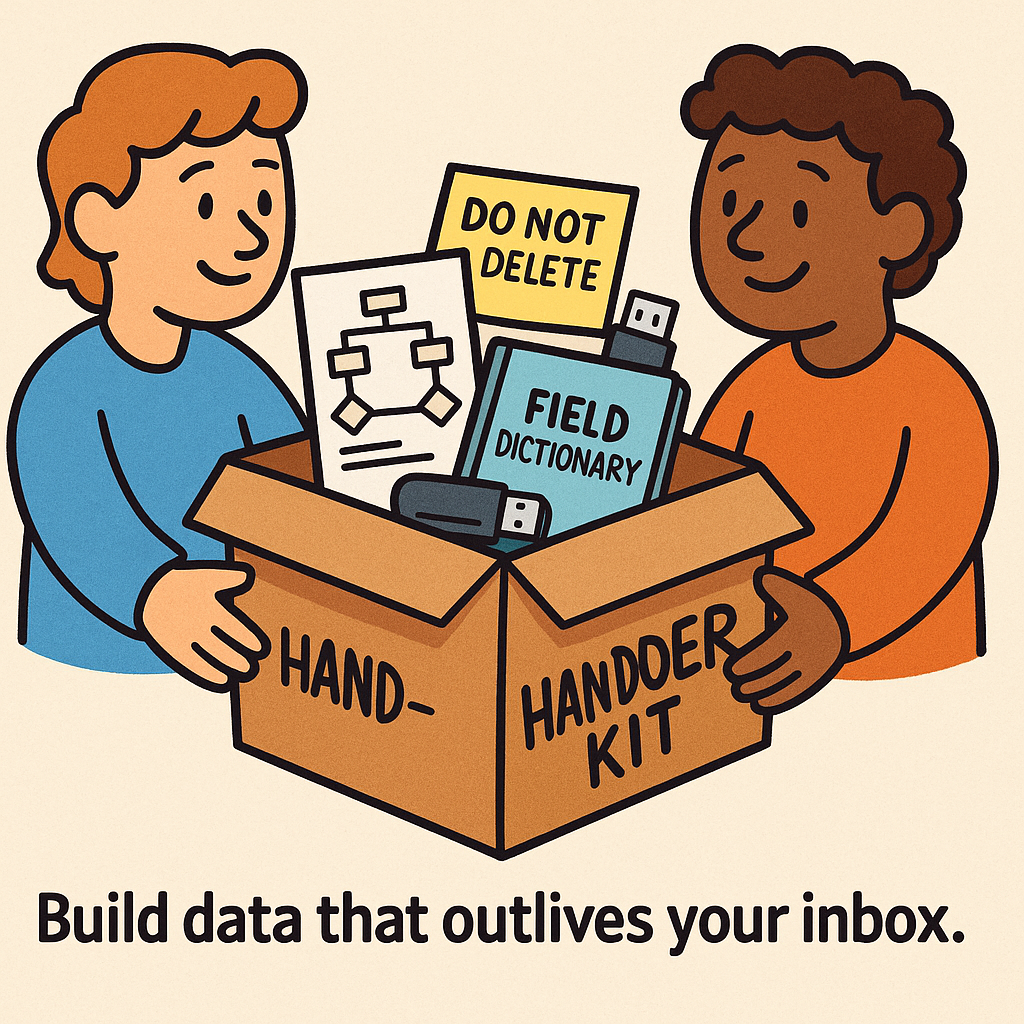
Staff changes are becoming more common. Even a basic handover document or internal wiki can make a huge difference.
5. Think Beyond Your Role
Even if you’re not a developer or architect, you can ask questions about long-term structure, ownership, and change management. You’re helping future-you – and future colleagues.
Long-Term Thinking Pays Off
Future-proofing isn’t about perfection. It’s not about building a system that never breaks or anticipating every possible scenario. It’s about designing with change in mind, recognising that people will leave, systems will evolve, and priorities will shift.
Good data work doesn’t live in isolation. It touches projects, people, and decisions well beyond the original brief. So the goal isn’t just to get it working for now, it’s to make sure the next person, or the next system, can pick it up and keep going.
If you’re doing the hard work to make data better today, to structure it well, to clarify its meaning, to turn it into something usable, then give that work the foundation it needs to stay useful, stay trusted, and stay relevant.
Because in the end, a future-proof system isn’t one that resists change. It’s one that’s ready for it.