
The Index of Multiple Deprivation 2025 has now been released.
For many institutions, this will sit quietly in the background. Access and Participation Plans are already agreed. Targets are set. Baselines were calculated using earlier versions of IMD. Regulatory dashboards haven’t visibly shifted yet.
So it’s easy to assume this is a “later” problem.
It isn’t.
Because IMD updates are not cosmetic. They have the potential to subtly, but materially, reshape how your student population is classified. And when deprivation quintiles shift, so can your access proportions, your continuation gaps, and your attainment narratives.
Nothing about your students may have changed. But the way the data describes them might.
That distinction matters more than most institutions realise.
Technology: The Reclassification Effect
At a purely technical level, IMD 2025 means new LSOA rankings and potentially new quintile allocations. Some areas will move up. Some will move down. That movement alone can reclassify students between quintiles.
If you were previously reporting that 28% of entrants came from IMD quintile 1 and 2, what happens if the same cohort becomes 25% under the new index? Or 31%?
Your widening participation performance has not improved or worsened. The classification framework has shifted.
If you do not model this early, you risk being surprised by your own data.
The technical task is straightforward: remap postcodes, rerun distributions, recalculate key APP metrics. But the implications are not purely technical.
Process: Governance, Narrative and Regulatory Readiness
Eventually, regulatory reporting will transition. The Office for Students will adopt the new index at some point. When that happens, institutions that have already done their modelling will be calm. Those that have not will be scrambling to explain changes in their figures.
This is where process maturity shows.
Do you know how sensitive your APP indicators are to deprivation reclassification? Have you stress-tested continuation and attainment gaps under IMD 2025? Have you considered whether historical baselines will need restating for comparability?
These are governance questions, not data questions.
Handled well, this becomes a controlled transition. Handled reactively, it becomes a narrative problem in committee rooms.
People: Confidence and Data Fluency
This is also a data fluency issue.
Senior leaders do not need to understand LSOA boundary methodology. But they do need confidence that when figures move, someone understands why.
IMD changes are exactly the sort of moment that separates reporting from fluency.
A fluent institution asks:
- What has changed?
- Is this performance or classification?
- How does this affect our strategy?
- What do we communicate externally?
A less mature institution simply waits until a dashboard changes and then asks why the number has moved.
If your data team can walk leadership through the impact of IMD 2025 before anyone asks, that builds trust. Quietly and powerfully.
This Is Not About Panic. It’s About Preparation.
There is no immediate regulatory cliff edge. OfS has not suddenly rewritten performance metrics overnight.
But that is precisely why this is the right moment to act.
You have breathing room. You can analyse calmly. You can brief thoughtfully. You can decide how and when to transition your internal reporting.
IMD updates are one of those small systemic shifts that reveal how well an institution connects its technology, its governance processes, and its people capability.
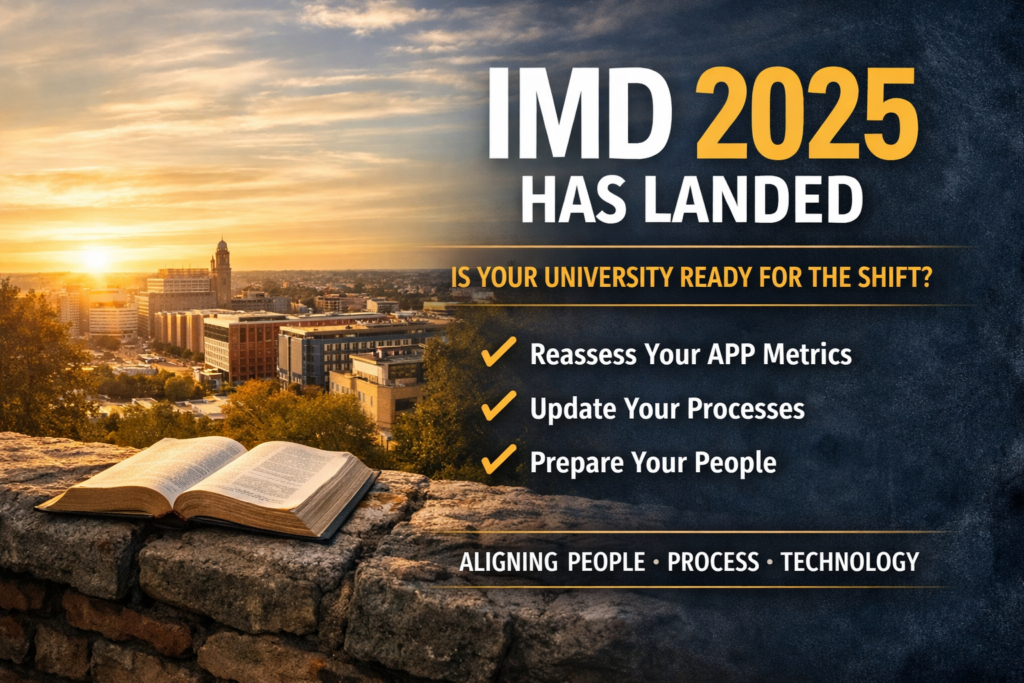
In other words, this is not just about deprivation data. It is a test of your People–Process–Technology alignment.
A Strategic Opportunity
If you approach IMD 2025 deliberately, you can use it to:
- Demonstrate analytical control
- Strengthen APP monitoring
- Improve geographic targeting
- Increase leadership confidence in your data
If you ignore it, you hand future-you an avoidable headache.
The question is not whether the sector will move to IMD 2025. It will.
The real question is whether you move first, or wait to be moved.