
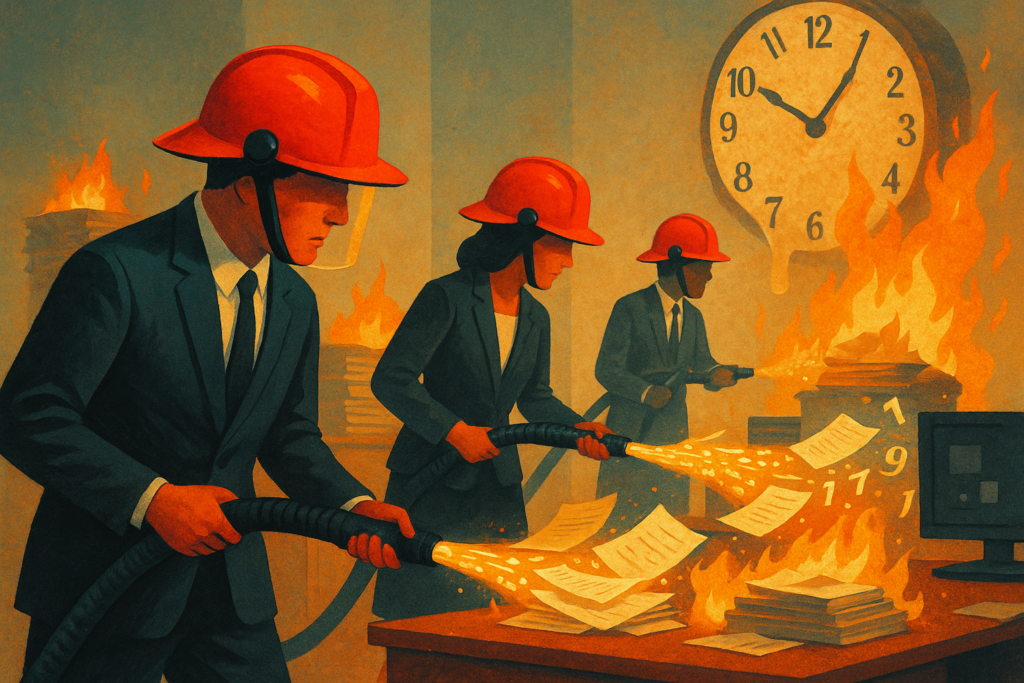
In many organisations, especially in professional services and higher education, firefighting is not an exception. It is the default mode of operation. Urgent emails, last-minute data requests, unexpected issues, looming deadlines that should not be looming. Everyone is busy, everyone is reacting, and somehow this is treated as normal.
Over time, constant urgency becomes background noise. When everything is urgent, nothing stands out as a sign that something is wrong.
Firefighting feels productive. People are visibly busy. Problems are solved quickly, at least on the surface. There is a sense of momentum and even a strange pride in coping under pressure. But coping is not the same as working well, and this distinction matters more than most organisations are willing to admit.
Why firefighting becomes the norm
Firefighting rarely starts because people are disorganised or incompetent. More often, it emerges from a combination of factors that slowly reinforce each other.
• Teams are sized to handle only the expected workload, not the variability
• Long-term planning is continually deprioritised in favour of immediate delivery
• Success is measured by responsiveness rather than sustainability
• Extra capacity is seen as inefficiency rather than resilience
Once this pattern is established, it feeds itself. There is no time to step back because stepping back feels like a luxury. There is no space to fix root causes because the next issue is already on fire.
When urgency becomes culture
Over time, firefighting stops being a response to genuine emergencies and becomes embedded in culture. New staff learn quickly that speed is valued over thoughtfulness. Saying yes quickly matters more than asking whether the request makes sense. Being constantly available becomes a proxy for commitment.
This is where firefighting becomes dangerous. Not because people are not working hard, but because the system itself is fragile.
A fragile system depends on heroics. It relies on individuals holding things together through effort, goodwill, and stress. It works until it doesn’t.
Firefighting hides deeper problems
The biggest risk of normalised firefighting is that it masks underlying issues.
Processes that generate repeated errors are never redesigned. Data problems are patched rather than fixed. Capacity constraints are absorbed silently by people working longer hours or cutting corners. From the outside, everything looks functional. From the inside, people are exhausted.
Because the organisation keeps moving, there is little incentive to change. The cost is spread across individuals rather than appearing clearly in budgets or dashboards.
A note on capacity
This series is not an argument for excess or waste. It is an argument for recognising that systems without slack are brittle.
Extra capacity is not about doing less. It is about creating space to do work properly. Space to anticipate problems rather than react to them. Space to improve systems rather than constantly compensate for them.
Firefighting feels normal because it has been normalised. That does not make it healthy, efficient, or inevitable.
In the next article, I will look more closely at the hidden costs of constant firefighting, and why organisations often underestimate the damage it causes precisely because it looks like productivity.