
Sixth in the “Tools for Data Governance” series.
In the previous post, we explored how metadata management connects data dictionaries, glossaries, and catalogs into a coherent ecosystem. This time, we turn to the people who make that ecosystem work.
Technology provides the structure, but people provide the care, attention, and decision-making that keep data reliable and meaningful. This is the role of data stewardship.
What Is Data Stewardship?
Data stewardship is the practice of managing and maintaining data so that it remains accurate, consistent, and properly governed throughout its lifecycle. While systems can automate certain checks, human oversight is essential to ensure that definitions make sense, rules are applied consistently, and data is used appropriately.
A data steward is the person responsible for the day-to-day quality and definition of specific data assets. They act as a bridge between technical teams, who manage databases and pipelines, and business users, who rely on data for decision-making.
In short, data stewards are the custodians of trust in an organisation’s data.
How Stewardship Differs from Data Ownership
Stewardship and ownership are often confused, but they play distinct roles within governance structures.
- Data owners hold ultimate accountability for a dataset. They are usually senior figures responsible for ensuring that data within their domain meets legal, regulatory, and strategic requirements.
- Data stewards carry out the practical management of that data. They maintain definitions, monitor quality, and ensure that standards are followed.
For example, the Director of Registry Services might be the data owner for student data, while a Data Quality Officer or Business Analyst acts as the steward, ensuring the accuracy and consistency of student information across systems.
Why Data Stewardship Matters
Strong data stewardship provides the human oversight that technology alone cannot. It ensures that data is not only stored correctly but also interpreted, maintained, and governed appropriately.
Key benefits include:
- Improved data quality through regular review and correction of errors
- Greater accountability by assigning clear responsibility for data definitions and integrity
- Faster problem resolution when data issues arise, as it is clear who to contact
- Stronger compliance with GDPR, HESA, and other regulations
- Better collaboration between IT, data teams, and business units
In short, stewardship turns data governance from a theoretical framework into an active practice.
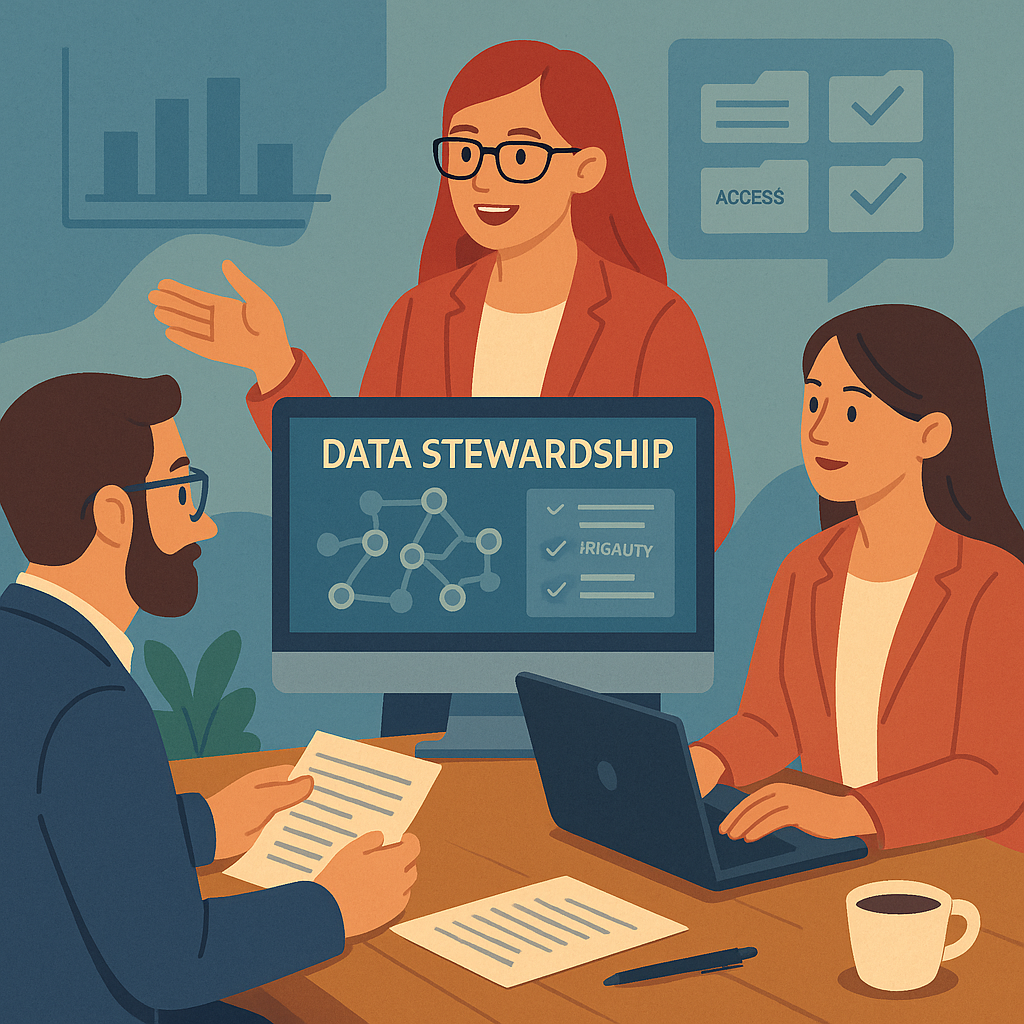
Embedding Stewardship in Higher Education
Universities are complex environments with multiple systems, departments, and data flows. Effective stewardship ensures that, despite this complexity, data remains trustworthy and aligned across the institution.
A practical model often includes:
- Assigning data stewards by domain.
For example, one steward might oversee student records, another staff data, another finance or research data. - Defining clear responsibilities.
Stewards should maintain definitions in the data dictionary and glossary, review data quality reports, and flag inconsistencies for correction. - Linking stewardship to governance processes.
Stewards should be part of data governance committees, ensuring that their insights inform institutional policy and reporting decisions. - Providing tools and training.
A data catalog or governance platform can support stewards by giving them visibility of the data landscape. Training helps them understand both regulatory obligations and the technical context of their work. - Recognising and supporting the role.
Stewardship should be formally recognised in job descriptions and workload planning, not treated as an extra task.
This structure helps establish stewardship as an integral part of the university’s data culture, rather than an optional add-on.
Building a Culture of Stewardship
While assigning roles is important, successful stewardship depends on mindset and culture. A mature data environment is one where everyone understands their relationship to data and feels responsible for its quality.
Encouraging this culture involves:
- Promoting shared understanding of why data quality matters
- Celebrating examples of data improvement and collaboration
- Making it easy for staff to report and fix data issues
- Providing regular communication between stewards, data owners, and governance leads
Over time, stewardship becomes part of how people work, not just a compliance exercise.
A Practical Example
Imagine a university developing a new student success dashboard.
- The data owner for student data ensures the project aligns with institutional policies and GDPR requirements.
- The data steward reviews field definitions in the data dictionary, confirms that “continuing student” matches the glossary definition, and checks that data quality rules are applied in the ETL process.
- The data catalog links the dashboard back to its source systems, showing lineage and responsibility.
When questions arise about numbers or definitions, the steward can explain the source, context, and meaning of each metric. This builds confidence in both the dashboard and the underlying data governance process.
The Takeaway
Data stewardship is the human element that gives governance life. It connects people to policy and ensures that data tools are used with understanding and accountability.
In higher education, where accurate data underpins compliance, funding, and student outcomes, stewardship is not optional. It is the steady, often unseen work that sustains trust in institutional data.